Anthropic launched Claude Managed Agents. CDN stocks plummeted >20%. The market is pricing stack compression and missing what actually matters: that easier AI drives more traffic overall, not less. TLDR: buy the sell-off (if you dare).
Claude Managed Agents internalize orchestration – the agent loop itself; i.e., reasoning, tool calls, and execution. To be clear, this is competition. Pulling orchestration inward means some logic that lived at the edge moves into their stack. The market panicked and assumed that Anthropic will now handle all of these back-and-forth loops internally, and that, consequently, the high-volume API traffic that CDNs profit from would vanish.
But pulling orchestration inward actually does three things at once; it:
Explodes the amount of orchestration.
Forces orchestration across models.
Still relies on the network to move it.
A little (distributed) history lesson, From the Porch.
When computing gets easier to consume, demand expands. The default abstraction lowers friction, usage ramps, and the system ends up needing more layers around it, not fewer. (TLDR: Jevons.)
You’ve seen this movie before. The cast barely even changed. Before Cloudflare was founded, AWS launched CloudFront, its integrated, easy-to-use CDN for anything already inside its ecosystem. It was the default: simple to turn on and good enough for a lot of use cases.
Cloudflare came shortly after with a different approach: an independent edge network sitting in front of everything: routing traffic, improving performance, and adding security across providers. As applications scaled, rather than consolidating around the (AWS) default, they enhanced their footprint. AWS CloudFront handled convenience inside AWS, while Cloudflare handled control, performance tuning, and multi-provider setups.
The result was Cloudflare grew to a ~$1.5B revenue and $30B company.
What the signals show (STAX).
You can see the (CDN) result in the data now. Porch Capital (i.e., I; i.e., Claude) recently built a (very) beta version of STAX (the STartup Architecture indeX) to track publicly observable signals of platform adoption. You can see that out of ~3,500 observable signals from >6K VC-backed startups, Cloudflare shows up 49% of the time compared to 32% for AWS CloudFront, despite AWS signaling more than half of startup cloud adoption.
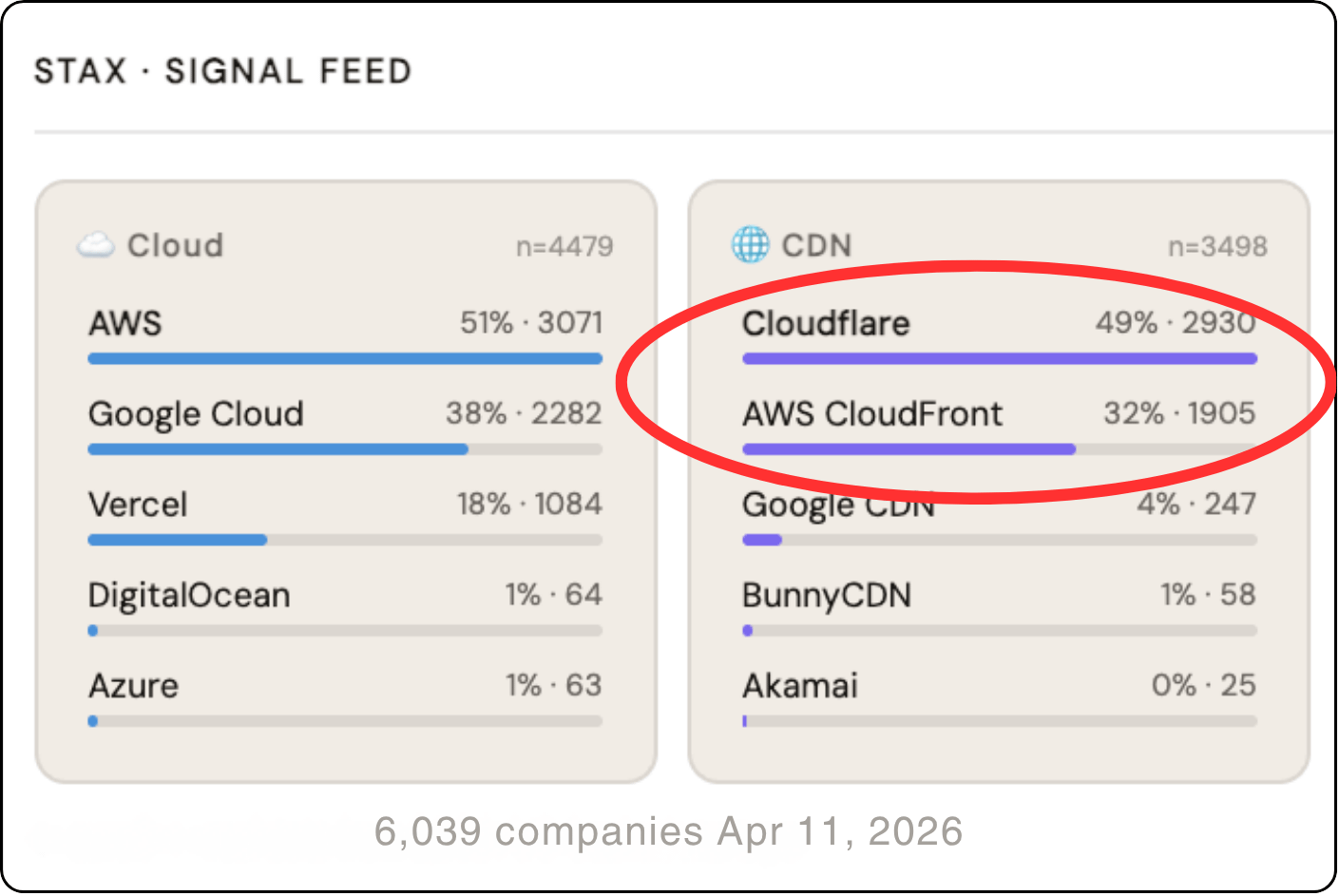
And this isn’t unique to startups. Across the broader Internet, third-party data shows Cloudflare at ~30% share vs ~5% for CloudFront.
AWS CloudFront didn’t kill the independent CDN layer — Cloudflare scaled into it. And managed agents won’t kill independent AI orchestration either.
The future is multi-model.
To believe Anthropic will eliminate the need for external and independent orchestration means you need to believe that the market will consolidate down to a single (Anthropic) model. And no serious system runs on one model. Different models win on different tasks, costs vary widely, and reliability matters — so workloads get routed, not locked in.

That independent orchestration and routing layer becomes more important, not less. Anthropic can own the cognitive loop, but the network owns the infrastructure loop. And as these workflows become more interactive and latency-sensitive, more of that orchestration gets pushed closer to the user, not pulled into one provider.
And every step in that loop still has to move — across regions, across providers, and back to the user. That increases the amount of traffic flowing through the entire system.
From the Porch: the system expands.
I get it. AI has us all on edge. We’re amidst a full “SaaSpocalypse” narrative right now. But this isn’t a layer getting eliminated. It’s the system expanding underneath it. More AI means more orchestration, more routing, and more traffic across all infrastructure: hyperscalers, neoclouds, and the edge.