


🥶 Capital flash-freezes just as the world builds the AI infrastructure it desperately needs, even as that same AI revolution is what has investors shitting their pants.
😱 Jamie Dimon says JPMorgan Chase is scurrying away from private credit, VCs and their LPs are stunned into wallet-clutching wondering what AI breaks next, and the entire capital stack suddenly has cold feet.
🤔 The paradox: the scarier AI gets, the more capital and infrastructure the world needs to build it.
🤑 The opportunity: if capital is too chicken-shit to fund the AI buildout, markets will build a new financial system to do it.
📈The new financial system turns compute into a tradable financial asset.
A SaaS-capalypse credit freeze (for now).
The SaaS-caplypse-induced flash-credit-freeze was punctuated by JPMC marking down the value of software-company loans in private-credit portfolios. TLDR: banks just tightened the leverage available to private credit funds, which means less capital flowing through the system. Tech (and software specifically) represents ~25% of the $2-3T private credit market. While private credit might look “small” compared to total tech financing of >>$20T, it sits alongside venture, PE, and public equity and is a much more significant portion of later-stage capital.
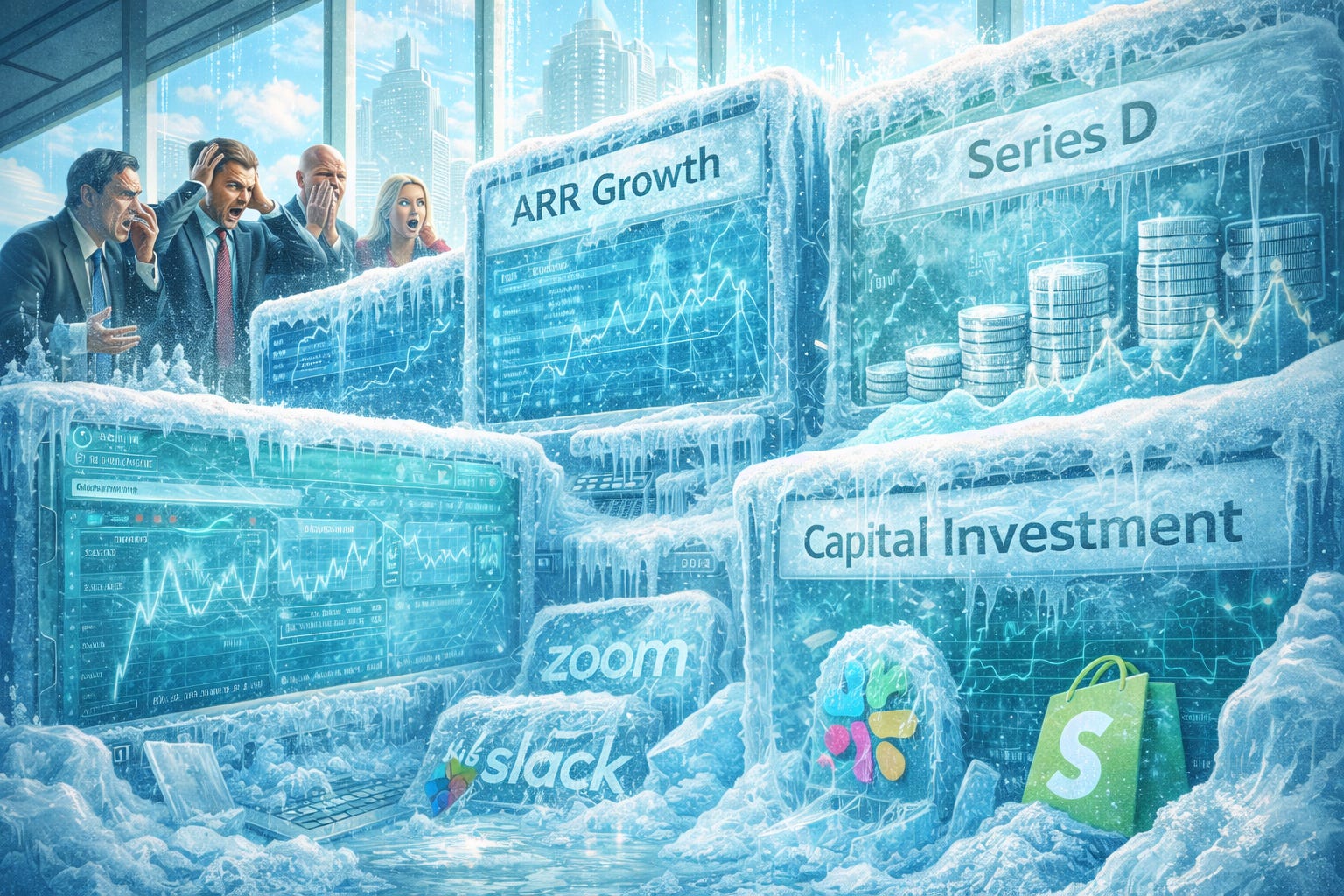
Meanwhile, in just the past few months (weeks?), venture capitalists descended into an existential crisis about wtaf they can invest in that is actually “AI-proof.” And their LPs are facing a comparable crisis of confidence. Combine that with what I’ll politely call an “uncertain geopolitical environment” and you’ve got the ingredients for a swift meltdown.
The AI capital paradox.
If capital freezes, AI disruption can’t happen. SaaS is safe.
If capital flows, AI disruption accelerates. SaaS is… less safe.
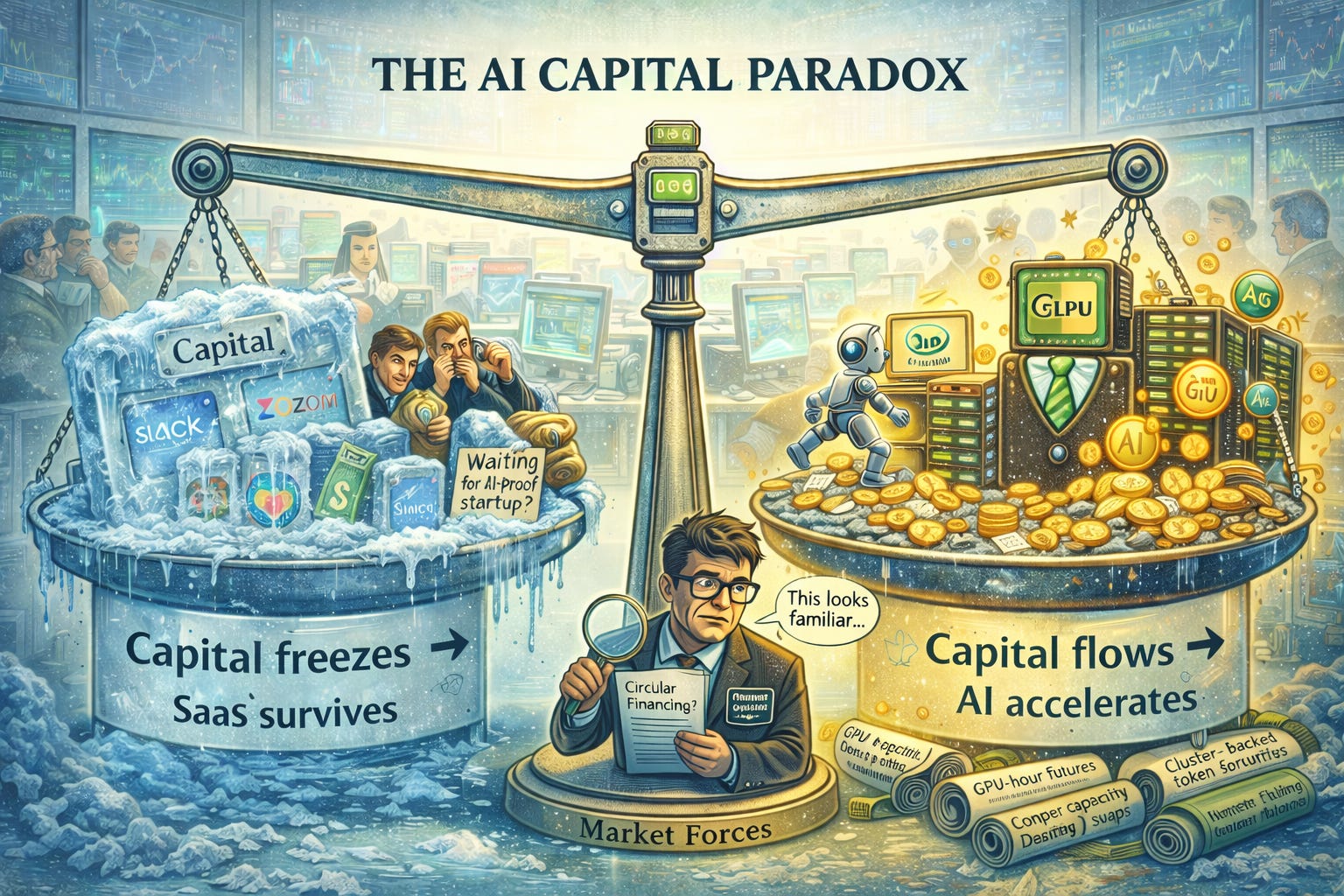
Both can’t happen simultaneously. My opinion: capital will find its way into AI infrastructure. For that to happen, a new financial system must emerge. You can already see the outlines forming.
Nvidia is acting like a merchant bank, helping finance customers’ GPU orders.
Hyperscalers are pre-committing billions in capacity deals.
Neoclouds are raising capital against future compute contracts.
Some of these structures look suspiciously circular, just ask Michael Burry. But that’s exactly how new infrastructure markets tend to bootstrap themselves. Railroads had speculative bonds. Oil had forward contracts. Electricity had power markets. Telecom had capacity pre-sales (which, in fairness, ended… poorly). AI infrastructure is now inventing its own financial plumbing.
Compute becomes the asset.
We are watching the emergence of a new financial asset: compute.
GPU hours, inference tokens, and reserved cluster capacity become the asset; not GPUs sitting in racks, but the output they produce. Once that output becomes predictable enough to contract against, it becomes financeable.
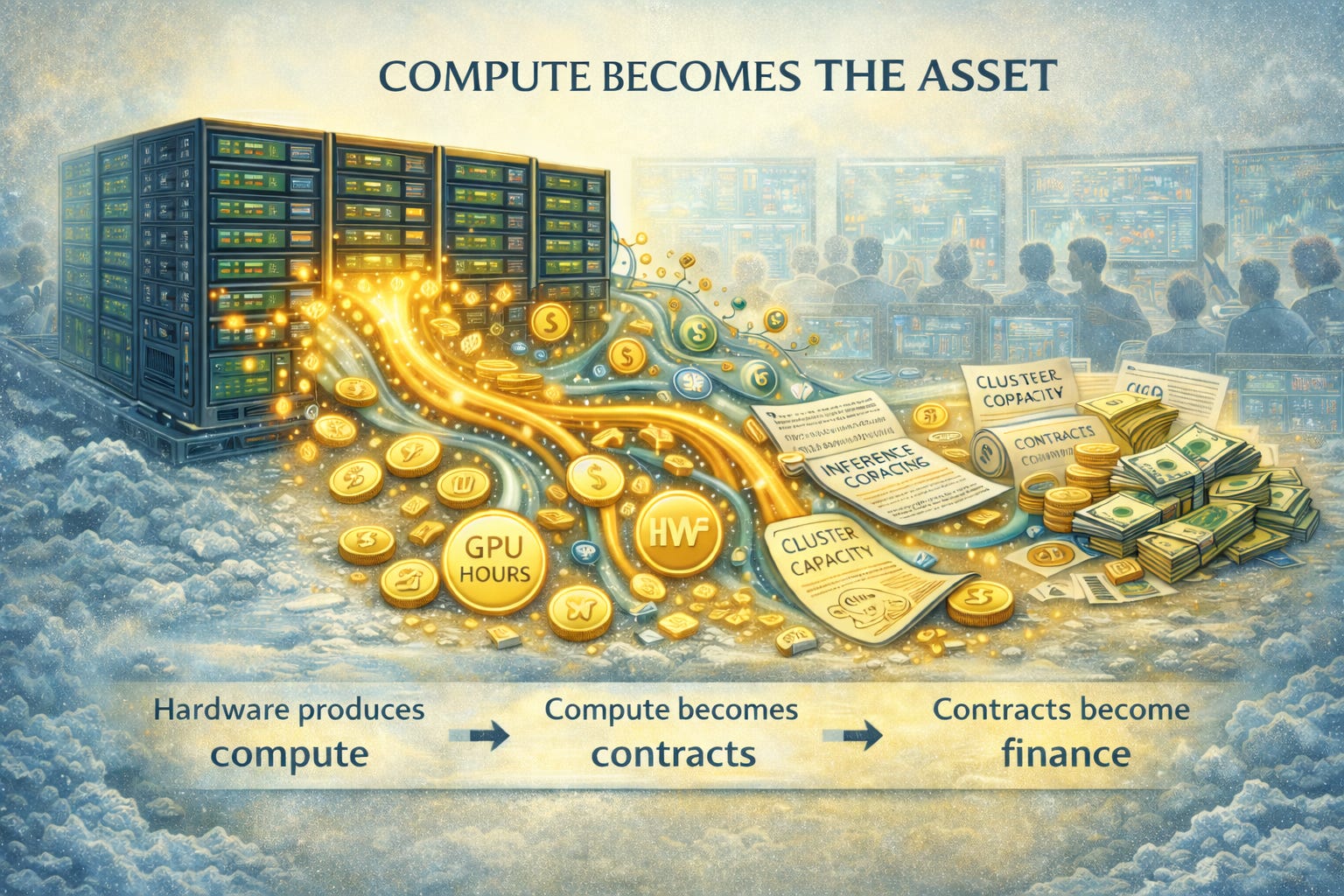
At first glance this might look like the neocloud financing deals we’ve already seen from companies like CoreWeave, who borrow billions against long-term contracts with hyperscalers like Microsoft, backed by private credit investors like Magnetar. Those structures still finance the company building the cluster.
The shift now underway is that finance begins organizing around the compute the cluster will produce. The compute output itself becomes the collateral rather than the infrastructure company, its hardware, or even its contracted revenue. Once compute becomes contractable, the financial system starts assembling around it.
Long-term compute contracts begin to resemble power purchase agreements in energy markets. Clusters get financed against those contracts. GPU leasing markets separate hardware ownership from compute usage. Hyperscalers and large buyers pre-commit to capacity years in advance, while neoclouds raise capital against future compute revenue.
What looks messy today — vendor (or, if you will, circular) financing, capacity pre-sales, forward compute deals — is the bootstrap phase of a market forming around a new asset.
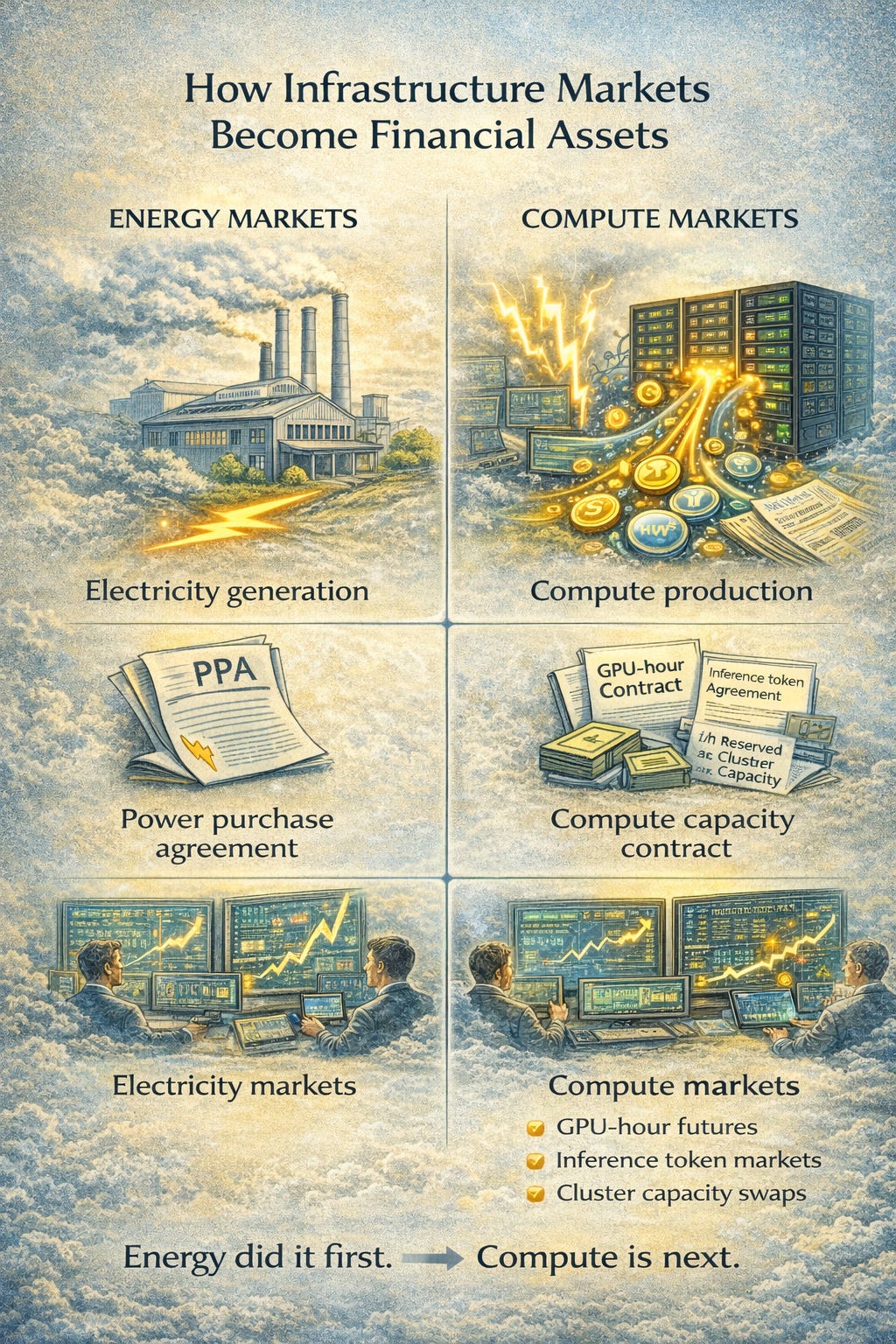
Energy markets followed the same path. First lenders financed utilities. Then they financed power plants backed by long-term power contracts. Eventually electricity itself became the asset markets traded and financed.
AI infrastructure is beginning the same transition.
Compute itself becomes the asset. And once that happens, the capital stack funding AI infrastructure expands far beyond venture capital or private credit.
Playing the compute economy.
So how do you play this?
The obvious trades are already well known. You can trade the chip stocks (NVDA, AMD, AVGO, QCOM) selling the picks and shovels into the AI buildout. And you can trade the compute platforms and infrastructure players (CRWV, NBIS, NET, DOCN, FSLY) aggregating GPU capacity. I’ve written plenty about that already (see: basically half my Substack). You can also chase the second-order effects like power generation, grid infrastructure, data center real estate, and the other physical constraints around AI infrastructure. Those trades exist, and plenty of people are already making them.
But the most interesting opportunity may be the financial layer forming around compute itself.
If compute becomes a contractable asset, entire markets start forming around it. GPU leasing. Cluster project finance. Brokers matching buyers and sellers of compute capacity. Eventually spot markets and forward markets for compute output: GPU-hours, inference tokens, reserved capacity.
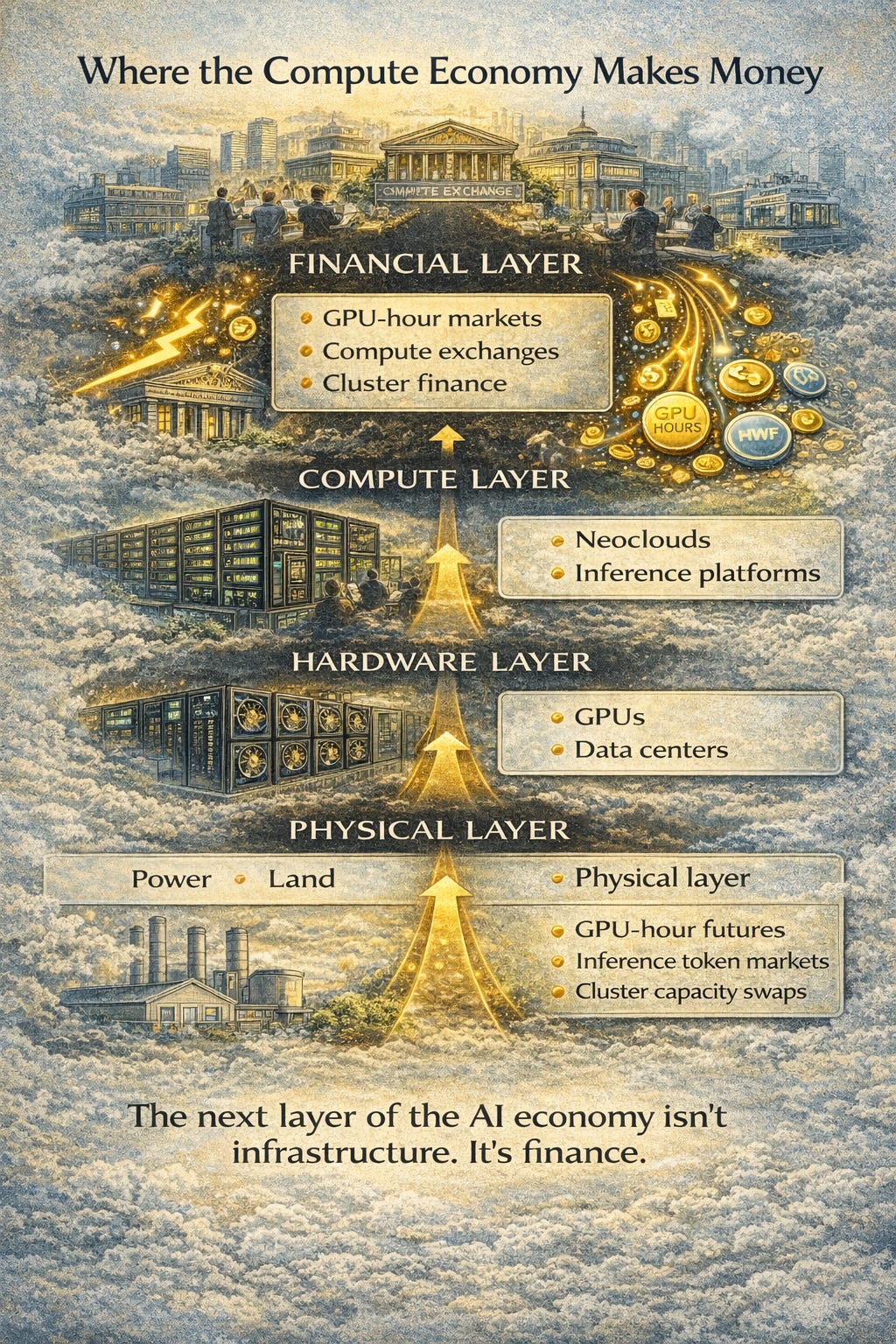
In other words, the AI economy will need merchant banks, exchanges, and markets for compute; not just chips and data centers. And the firms that build those markets may ultimately capture as much value as the infrastructure companies themselves.
And who knows…. Maybe the AI economy builds its own financial system.
USAi Tomorrow - From the Porch.
When an input becomes essential to the global economy, markets inevitably figure out how to finance it.
First it was oil.
Then electricity.
Then bandwidth.
Now it’s compute.
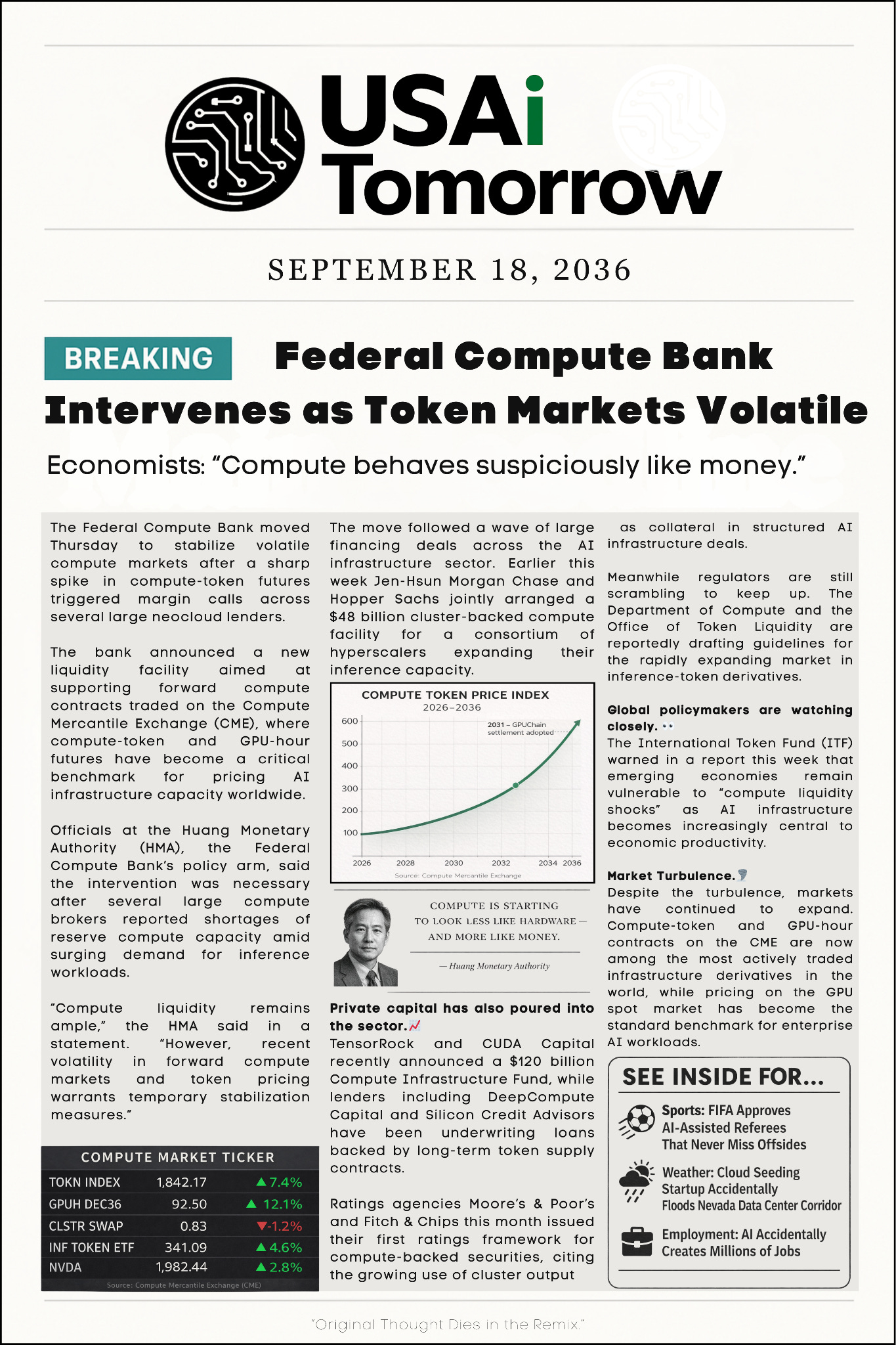
WASHINGTON, September 18, 2036 — The Federal Compute Bank moved Thursday to stabilize volatile compute markets after a sharp spike in compute-token futures triggered margin calls across several large neocloud lenders.
The bank announced a new liquidity facility aimed at supporting forward compute contracts traded on the Compute Mercantile Exchange (CME), where compute-token and GPU-hour futures have become a critical benchmark for pricing AI infrastructure capacity worldwide.
Officials at the Huang Monetary Authority (HMA), the Federal Compute Bank’s policy arm, said the intervention was necessary after several large compute brokers reported shortages of reserve compute capacity amid surging demand for inference workloads.
“Compute liquidity remains ample,” the HMA said in a statement. “However, recent volatility in forward compute markets and token pricing warrants temporary stabilization measures.”
The move followed a wave of large financing deals across the AI infrastructure sector. Earlier this week Jen-Hsun Morgan Chase and Hopper Sachs jointly arranged a $48 billion cluster-backed compute facility for a consortium of hyperscalers expanding their inference capacity.
Private capital has also poured into the sector. TensorRock and CUDA Capital recently announced a $120 billion Compute Infrastructure Fund, while lenders including DeepCompute Capital and Silicon Credit Advisors have been underwriting loans backed by long-term token supply contracts.
Ratings agencies Moore’s & Poor’s and Fitch & Chips this month issued their first ratings framework for compute-backed securities, citing the growing use of cluster output as collateral in structured AI infrastructure deals.
Meanwhile regulators are still scrambling to keep up. The Department of Compute and the Office of Token Liquidity are reportedly drafting guidelines for the rapidly expanding market in inference-token derivatives.
Global policymakers are watching closely. The International Token Fund (ITF) warned in a report this week that emerging economies remain vulnerable to “compute liquidity shocks” as AI infrastructure becomes increasingly central to economic productivity.
Despite the turbulence, markets have continued to expand. Compute-token and GPU-hour contracts on the CME are now among the most actively traded infrastructure derivatives in the world, while pricing on the GPU spot market has become the standard benchmark for enterprise AI workloads.
Most compute contracts now settle via GPUChain, the proof-of-compute settlement layer adopted by major hyperscalers in 2031.
For now, officials say the system appears to be functioning as designed.