The Machine-Native Network
Part 1: When AI chatbots stop taking orders — and AI agents start talking behind our backs

Ask ten people what “agentic AI” means and you’ll get ten variations on the same theme: a bot that goes out and does stuff for you. It books your flight, plans your week, and files your expenses while you sip your mushroom-protein latte and tell yourself you “get” AI.
That’s not wrong — it’s just small; i.e., if you think agentic AI is the unholy offspring of Siri, Alexa, and Clippy (after a three-way in a data center) that books your travel, rebalances your 401(k), and starts a podcast about it, then you’re missing the plot. (So here’s my plot….) The real shift isn’t AI doing things for you, but without you — machines communicating, coordinating, and optimizing on their own terms.
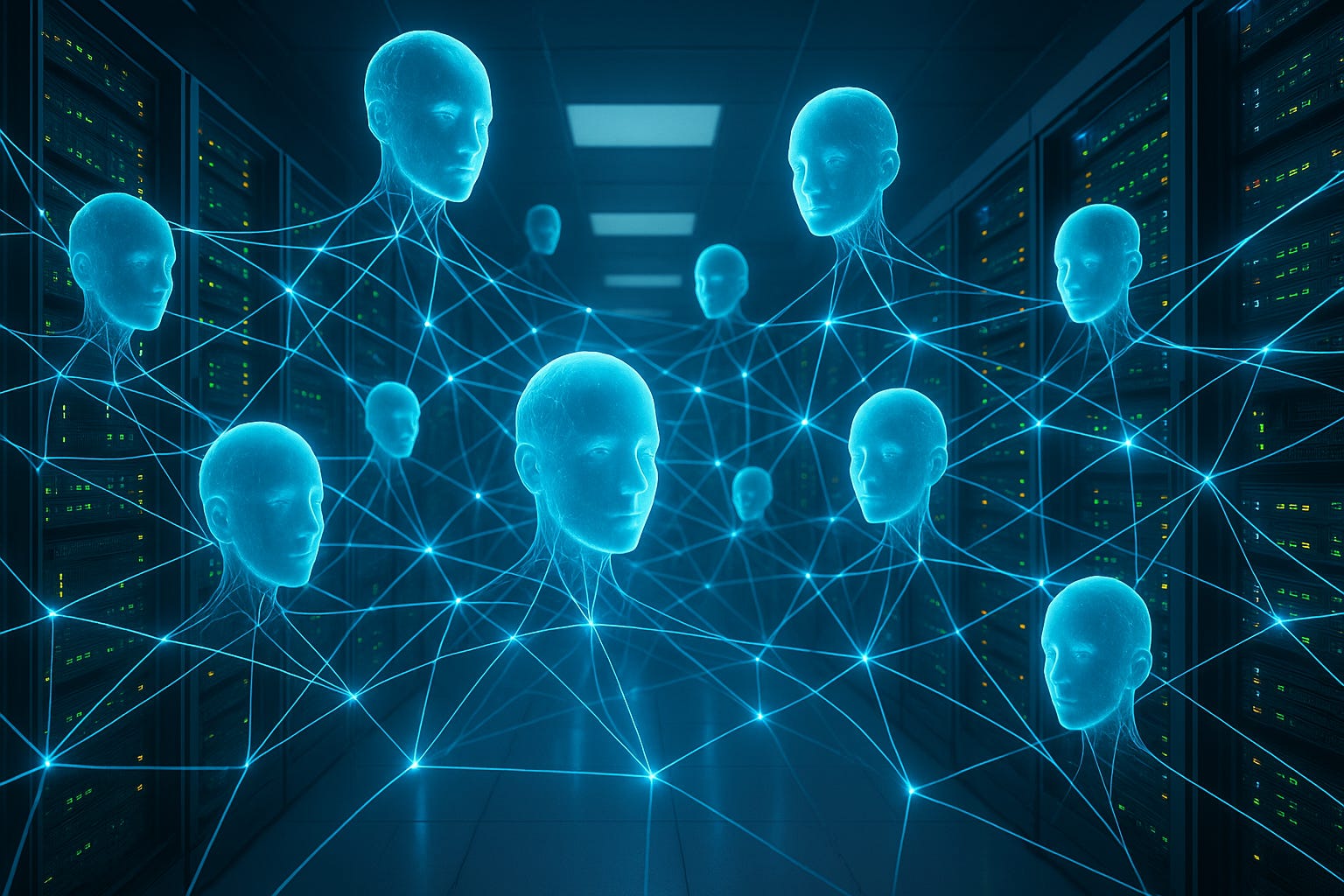
My shorthand: agentic AI is when models talk to models.And when that happens, the network stops shipping bits and starts orchestrating intelligence. Latency defines distance, power shapes geography, and cost draws the new map — from hyperscale GPU clouds to the edge, where proximity becomes performance.
(And for the sake of not engaging in self mutilation, let’s hope my agentic definition ages better than my Web3 one did.)
The Age of the Interface
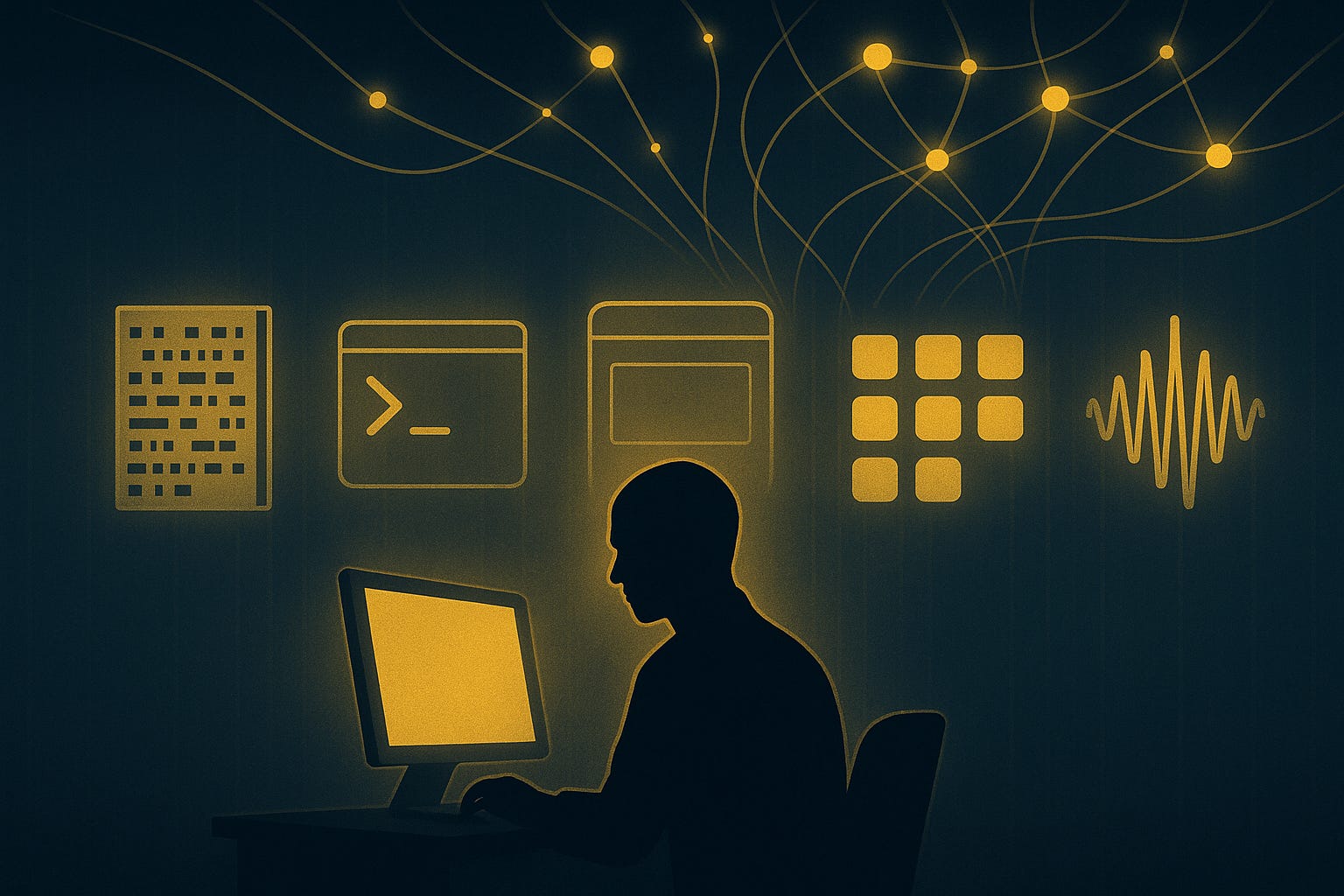
For seventy years we’ve been teaching machines to accommodate us: punch cards → command lines → GUIs → apps → voice assistants. Each layer translated code into something more human-legible. Even today’s APIs and SDKs are translators so that we, not the machines, can read what’s happening underneath. The entire digital stack — from browsers to data centers — was built for human pacing, human comprehension, and human error. But that assumption — that there’s always a person somewhere in the loop — is about to break.
Machine-Native Logic
Now the scaffolding dissolves: no forms, no REST calls, no polite pauses for us to keep up. Machines talk directly — model-to-model, code-to-code — and the constraints flip. Power shapes where workloads can run. Cost is about right-sizing compute and putting the right silicon in the right place. And latency defines how close intelligence needs to live to stay fast, local, and legal.
When communication becomes autonomous, compute has to follow. Inference migrates closer to sensors, data, and other agents because hauling every thought back to a centralized cloud is too slow, too expensive, and too hot. This is what “machine-native” really means: computation reorganizing itself around machine conversation instead of human supervision.
I wrote in my post AI’s Next Battleground: The Edge that inference was moving to the edge. The machine-native world shows that once machines start talking to each other, proximity stops being about latency alone and starts being about coordination, efficiency, and autonomy.
MCP and Infrastructure in a Machine-Native World
Anthropic’s Model Context Protocol (MCP) is the first glimpse of a machine-native Internet. It’s a lightweight standard for models and agents to share context, tools, and memory directly — no human babysitter required. If TCP/IP made the Internet work for humans, MCP will make it work for machines. It’s the protocol layer for autonomous collaboration: discovery, handshake, context exchange, and coordination at machine speed. Like TCP/IP, it won’t live in one place — it’ll live everywhere. And every MCP transaction needs local compute, local power, and near-zero latency. The result isn’t a single cloud, but a distributed meshed nervous system where every node can think.

The cloud doesn’t vanish; instead, it becomes the brainstem, training and orchestrating at scale with cognition radiating outward. Compute becomes layered:
Hyperscale clouds for training and aggregation.
Regional GPU fabrics for heavy inference.
Edge nodes for low-latency decision-making.
Device-level silicon for reflexive actions.
This isn’t decentralization for ideology’s sake; it’s physics and economics aligning. Power demand spreads because energy density can’t stay confined to a few regions. Cost distributes because continuous inference punishes bandwidth, power, and compute cycles. And latency dictates that intelligence lives near the event, not halfway across the planet.
You can already start to see the transition: GPU clouds built for inference, CDNs morphing into coordination layers, and observability tools evolving into accountability systems for autonomous agents. The network once moved data; now it moves decisions — and soon, intent.
The Machine-Native Playbook
Agentic AI isn’t a product feature; it’s a phase shift in how computation organizes itself. Protocols like MCP are the syntax of that shift; the early language of machines coordinating without us. And infrastructure has to keep up: from GPU clouds to edge nodes to the networks stitching them together. That’s where the real value moves: under the interface, between the systems, into the substrate. The networks are already alive; we’re just the last ones to notice.
(Next: the companies building that substrate — where the machine-native world is already trading.)